
Smith County Previous Residents by Era
A backward address search works best when each source is used for its own date range and purpose. The County Clerk's official index is the recording route. Historical directory and criss-cross volumes are the occupancy route. A census schedule supplies a dated household snapshot, while maps and permits explain the building or street. The online deed portal is current but does not state its first online year, so a blank result does not prove that a past owner or occupant was absent from Smith County.
| Source | Years it covers | Where held | What it shows |
|---|---|---|---|
| County deed books and index microfilm | 1846 to 1906 record series; index reels 1846 to 1888 and 1888 to 1901 | County Clerk originals and the Texas State Library guide | Title parties, legal descriptions, liens, plats, and instrument dates |
| Official online deed index | Current portal; online start year not stated | Smith County Official Public Records Search | Grantor, grantee, subdivision, document type or number, recorded date, and OCR search |
| Tyler and Smith County directories | 1882 to 1999 listed years, with gaps | Historical Society, Tyler Library, and selected state-library holdings | Names, addresses, street or householder placement, telephone in later volumes, and business context |
| Federal census schedules | Release is governed by the 72-year rule | National Archives path and library genealogy tools | Household members, ages, relationships, occupations, and enumeration location |
| Tyler permits and the 1902 Sanborn maps | Current availability for permits; November 1902 for the confirmed map set | Tyler Development and Planning; Library of Congress | Work or inspection sequence, building form, street context, and adjacent structures |
For a recent transfer, start with the parcel and deed. For an older household, start with the closest surviving directory issue, then test it against the released census. For an early title question, use the official microfilm guide and County Clerk route rather than relying only on the public portal.
Smith County Parcel Details First
Before tracing past residents, freeze the current parcel facts. The Smith County Tax Assessor-Collector search distinguishes owner name, owner address, property location, and account number. For a property-location query, its help says to enter the street number and name without the street type or direction. Record the property location, account number, owner name, owner mailing address, tax or appraisal details shown, parcel or legal-description references, and map link.
The owner mailing address is not proof that the owner lived at the property. It can be a post office box, another address, a business, or a service address. The same caution applies to a homestead or exemption indicator: it can be useful owner-occupancy evidence, but it is not a live roster. Use the Smith County Appraisal District and its approximate map boundaries as parcel tools, then use dated historical sources for occupants.
Note: Save the account and legal-description details before a search appears to jump, because accounts can be split, merged, renumbered, or updated after a transfer.
Smith County Deed Chain Backward
The title trail begins with the current owner and moves backward through recorded parties. At the Smith County Clerk Official Public Records Search, the Property Records quick and advanced screens support a broad search term, recorded-date range, date presets, and index-only or index-and-full-text OCR scope. The portal states that a term can be a grantor or grantee, subdivision, document type, or document number. Treat the index row as a pointer, then read the instrument and its legal description before connecting it to an address.
- Confirm the current parcel in the tax or appraisal search and copy the owner name, situs, account, subdivision, lot or block, and legal description shown.
- Search the current owner as a grantee in the official records index, narrow by recorded date, and identify the acquisition instrument and seller.
- Save the deed type, recording date, document number, and legal description, then search that seller as an earlier grantee.
- Repeat name variants for estates, trusts, corporations, married couples, and spelling differences while comparing the lot, block, survey, acreage, or subdivision terms.
- When the live index no longer produces the next link, move to deed books or index reels instead of assuming the chain ended.
- Grantor and grantee
- The grantor is the party conveying an interest in an instrument. The grantee is the party receiving it.
- Chain of title
- The sequence of recorded transfers and related instruments used to follow an interest in a parcel through time.
- Legal description
- The lot, block, subdivision, survey, acreage, or other land description in an instrument. It is often more stable than a street address.
- Instrument index
- A searchable pointer to a recorded document. It is not a substitute for reading the document or ordering the needed copy.
Smith County Deed Records Offline
The public index does not disclose an online start year. Older work has a documented fallback: the Texas State Library and Archives Commission guide for Smith County lists deed records beginning in 1846, index reels for 1846 to 1888 and 1888 to 1901, and deed volumes through 1906. The County Clerk retains later volumes in its custody. Ask for a specific volume, reel, instrument, case, or record group when an online search fails.
Records Services is another local route for inactive county material. It coordinates retention and microfilm access, while the County Clerk remains the custodian for official public records. Under the Texas Public Information Act, request an existing identifiable record instead of asking an office to create a fresh list of past residents. A watermarked preview, a downloaded copy, and a certified copy are different products. The County Clerk's portal information says downloaded copies are $1 per page for Pay-As-You-Go accounts, and a preview is not a certified record.
The official records search screen shows the recorded-date controls and index or OCR scope available for the first online step.
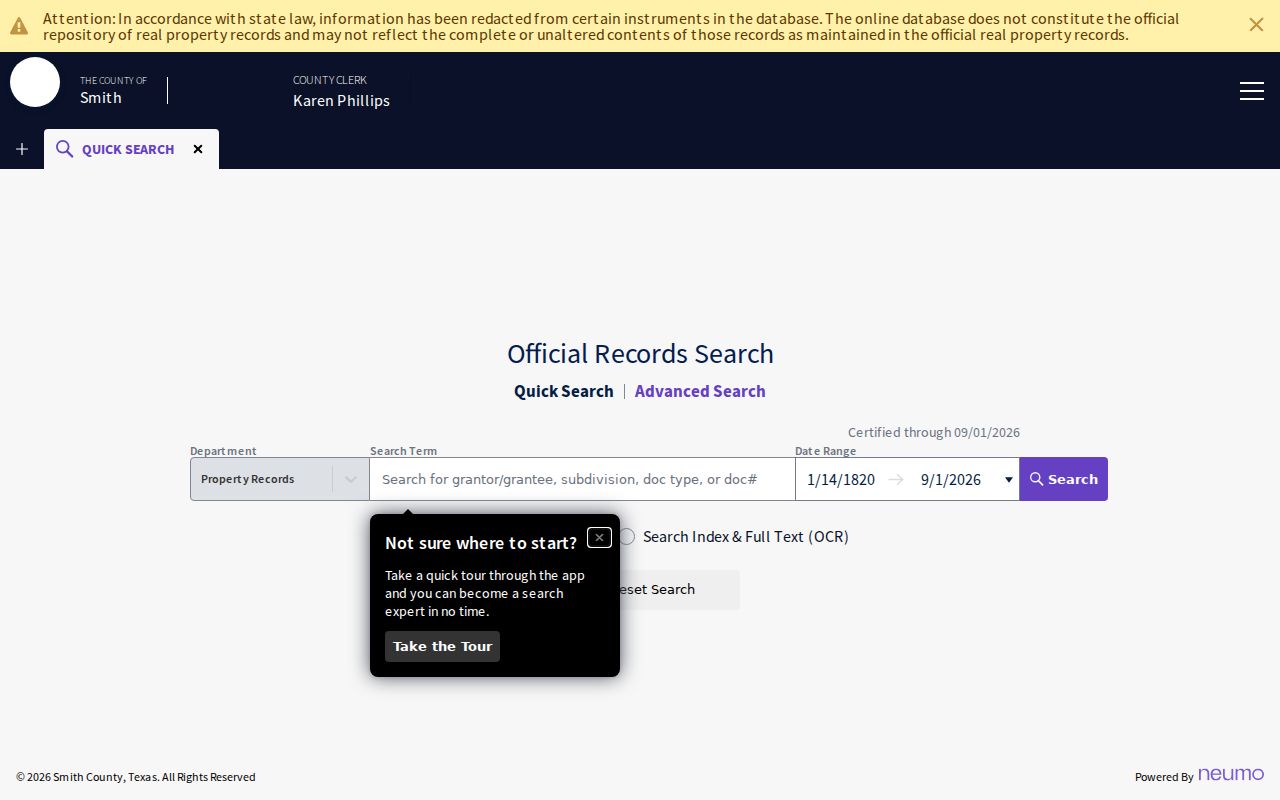
Use the search controls to narrow a party or subdivision result, then preserve the legal description and document number for the offline follow-up.
Smith County Address Continuity
A street address can change while the underlying parcel description remains useful. Tyler grew beyond its original grid around the courthouse square through numbered streets, subdivisions, highways, annexed areas, and unincorporated pockets. The research did not locate an authoritative citywide renumbering or street-renaming list. Compare old street guides, plats, adjacent intersections, subdivision information, and the legal description before deciding that two differently worded addresses are the same place.
The SCAD interactive map can show parcel geometry, roads, districts, and adjacency, but its boundaries are approximate and are not a survey. In some parts of the county, municipal zoning or permit responsibility also differs from county responsibility. The city directs address-limit checks to the Smith County map site. Those boundaries explain why a permit or planning file might be held by Tyler for one parcel and a county office for another.
Smith County Previous Residents in Directories
Ownership is only one trail. Tyler and Smith County city and criss-cross directories can identify who a publisher listed at an address, including occupants who did not own the parcel. The historical collections themselves are described in the Smith County Directory Book. Use the street or householder section to search from an address, then return to the alphabetical portion for occupation, a business listing, or a later telephone reference. Keep the edition year with the result.
Past residents can disappear for many reasons: a move, death, name change, coverage change, or omission. Never convert that gap into a conclusion by itself. The Historical Society has criss-cross directories, house vertical files, maps, yearbooks, newspapers, cemetery resources, and family files. Its archive use is by appointment, with staff pulling material after a detailed request. Tyler Library offers local-history appointments, microfilm, a scanner, and research requests through its Local and Family History room.
Lawful use. Smith County house-history research is for family history, estate or heir work, and personal curiosity. Do not use a past address or record to stalk, harass, or harm a living person.
Smith County Census Pairing
Directories and census schedules answer different questions. A directory can place a name at a street address near a publication date. A released federal census schedule can show household members, ages, relationships, occupations, and enumeration location. They should be paired as dated clues, not merged into one record. The research recommends using surviving directory years from 1900 through 1999 alongside the corresponding released census decade, while remembering that the dates of collection can differ.
- Find the closest available directory issue and capture the exact street form, household or business placement, and edition year.
- Locate the closest released federal census schedule and compare the name, age, relationship, and enumeration location.
- Check the next available directory issue for a move, a new listing, a missing telephone, or a name variation.
- Use a deed for ownership, a probate case for heirs or estate property, and a newspaper or obituary for a dated family endpoint.
County probate indexes are online for the documented modern range, while images for that range are office-only. Earlier probate papers, dockets, and minutes have separate microfilm coverage. An obituary can name relatives and a date or place, but a certified fact should be confirmed with the appropriate custodian.
Note: A census address or directory listing can place a household at one time, but it does not establish the current whereabouts of anyone named.
Smith County House Files and Maps
For the physical history behind a record trail, use the November 1902 Tyler Sanborn map. Its 14 sheets can show that a building or street form existed by that month, along with construction materials, hydrants, nearby buildings, and neighborhood form. It cannot identify an occupant. Pair it with a nearby directory issue or deed instead of treating the map as a people record.
The Historical Society keeps house vertical files by street name, historical and Sanborn maps, and virtual house files. Tyler Development and Planning uses eTRAKiT and ProjectDox for a construction, alteration, or inspection sequence at an address in Tyler jurisdiction, with a Texas Public Information Act request as a fallback for existing records. A permit applicant or dated work item can inform a house history, but it is not proof of a household roster.
Smith County's 2025 Historical Atlas initiative adds historic routes, landmarks, cemeteries, and popup records to the address-context work. It is useful when an old community or road name needs explaining. It is not a current-person source.
Smith County Previous Residents Limits
Each stop in the trail has a limit. A deed identifies parties to a recorded instrument, not every person living on the parcel. An appraisal card can show an owner and mailing address, not a complete household. A directory reflects a publisher's method and date. A Sanborn sheet shows structures, not names. Protected addresses, sealed court material, recent vital certificates, utility customer records, and other confidential information remain outside an ordinary address search.
Keep uncertain links marked as leads. When a record is needed for an estate, family-history conclusion, or property question, obtain the actual document from the custodian and compare its dates, parties, and legal description with the rest of the trail. That preserves the difference between a promising search result and a supported conclusion.