
Smith County City Directory Collections
The Smith County Historical Society directory holdings identify a long Tyler and county run from 1882 through 1999. It is not a continuous annual series. The earliest books mix local history and business material with names, while later volumes divide alphabetical listings, street guides, telephone material, and classified pages. The holdings page is the safest place to choose a starting year because it names the publisher and the type of sections in each run. Tyler Library confirms that it also keeps Tyler and Kriss Kross volumes for hands-on research.
| Collection | Years | Where held | Access |
|---|---|---|---|
| Gardner, Gazetteer, Mims and Buckner volumes | 1882 to 1910, selected issues | Smith County Historical Society | Archive appointment and copy request |
| Worley, Pruden and Polk volumes | 1913 to 1999, with gaps | Historical Society; selected Tyler Library and Texas State Library holdings | In-person research; some copy options |
| Kriss Kross and street sections | Various years within 1882 to 1999 | Historical Society and Tyler Library | Staff-mediated archive or library use |
| Portal to Texas History collection | Date browsing and digitized items vary | University of North Texas | Free online collection search |
The table is a shelf map, not proof that every issue is online. The Historical Society list includes annual and biennial stretches as well as missing years. The Texas State Library's physical Tyler list overlaps the later decades but does not replace the broader local inventory.
The Historical Society's directory holdings page records the publisher and year-run details behind this collection.
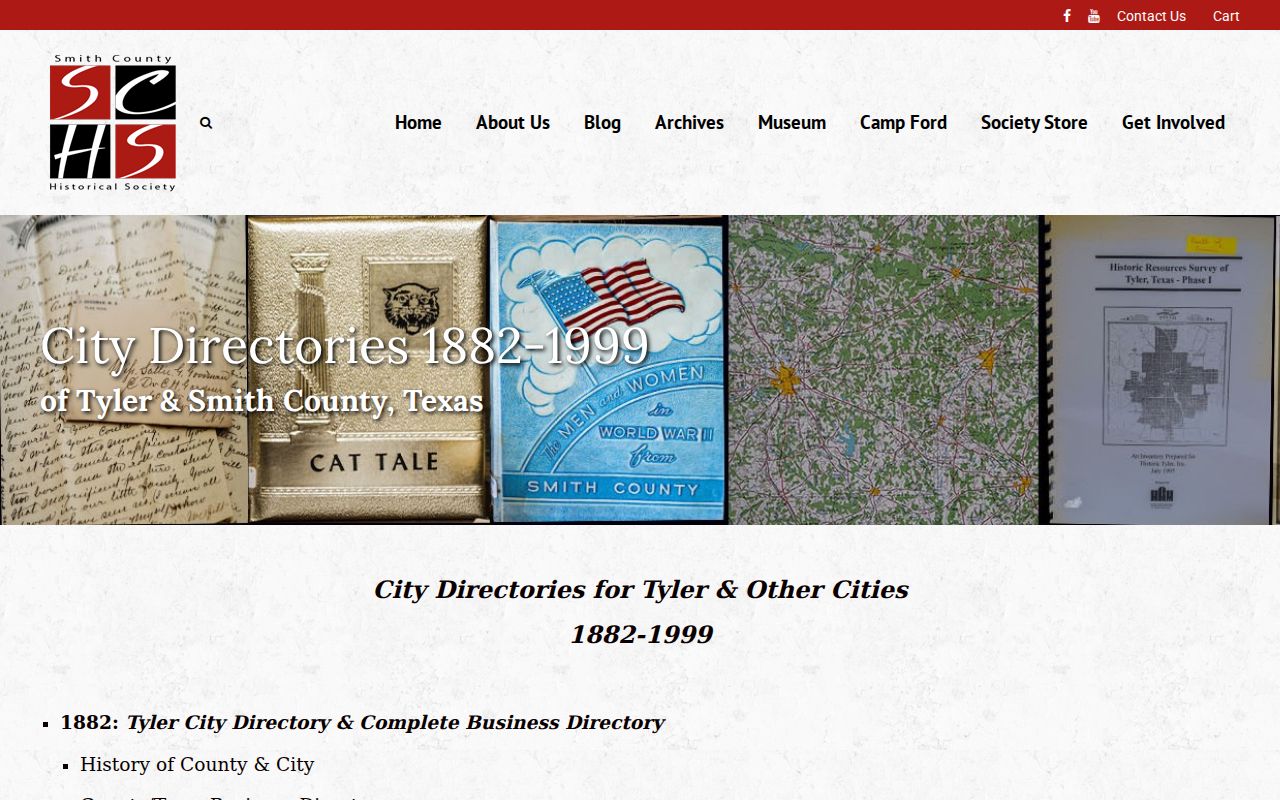
Use the listed year and publisher to request a specific volume, rather than asking staff to search an entire century of directories.
Smith County City Directory Beginnings
The local shelf begins with the 1882 Tyler City Directory and Complete Business Directory by C. M. Gardner and L. M. Green. An 1882/83 Tyler extract and an 1884/85 Troup and Tyler extract came from the Texas State Gazetteer and Business Directory. By 1890/91, the Gazetteer material reached communities including Bullard, Flint, Garden Valley, Lindale, Troup, Whitehouse, and Winona. That county breadth matters when a family used a Tyler mailing or trade connection but did not live inside Tyler.
The 1904 City of Tyler Directory added firms, private citizens, a street and householders' guide, officers, courts, churches, schools, banks, depots, railways, and organizations. The 1910 Courier-Times volume kept a similar household, government, business, and organization pattern. These early books can supply a time and place, but their inclusion rules were commercial and historical, not a complete count of everyone who lived in Smith County.
Note: An 1887 volume describes an alphabetical list of white inhabitants, so older entries must never be treated as a complete population roll.
Smith County City Directory Publishers
Publisher changes help explain why the fields change. Worley's 1913 book offered citizens and businesses, classified listings, and a street guide. Pruden's 1918 volume added rural mail routes with assessed valuation. Polk's 1923/24 directory included full names, occupation or pursuit, address, a householders' and street guide, and buyers' and classified material. Later Worley and Polk issues carried the familiar alphabetical and street formats in annual or biennial runs.
- 1882: Gardner and Green published the first identified Tyler directory on the local shelf.
- 1904: Buckner's Southern Directory Company volume included a street and householders' guide.
- 1913 to 1918: Worley and Pruden issues added classified and rural-route context.
- 1923 to 1991: Worley and Polk runs developed the repeated alphabetical, street, householder, buyer, and classified formats.
- 1993 to 1999: Polk volumes used White Pages, Yellow Pages, a street-address section, numerical telephone material, and a demographic summary.
| 1882 to 1918 | Gardner, Gazetteer, Mims, Buckner, Courier-Times, Worley, and Pruden issues combine local description with names, businesses, and street material. |
|---|---|
| 1923 to 1956 | Polk and Worley issues emphasize alphabetical, householder, street, buyer, and classified sections. |
| 1958 to 1973 | Polk volumes add numerical telephone and Yellow Pages or special-advertising material. |
| 1974 to 1991 | Polk volumes list four parts: Buyer’s Guide or Classified, Alphabetical, Street Directory of Householders and Businesses, and Numerical Telephone. |
| 1993 to 1999 | Later Polk volumes use White Pages, Yellow Pages, a Blue street-address directory, numerical telephone material, and then a demographic summary. |
For digitized searching, the UNT Portal to Texas History City Directories collection offers keyword, guided, advanced, proximity, and date browsing. Its accessible 1904 date view shows one item, but research did not confirm that it is a complete Tyler volume. Check the item metadata and images before treating a search result as a full local run.
The UNT city-directory collection provides the online browse and search interface for digitized material.
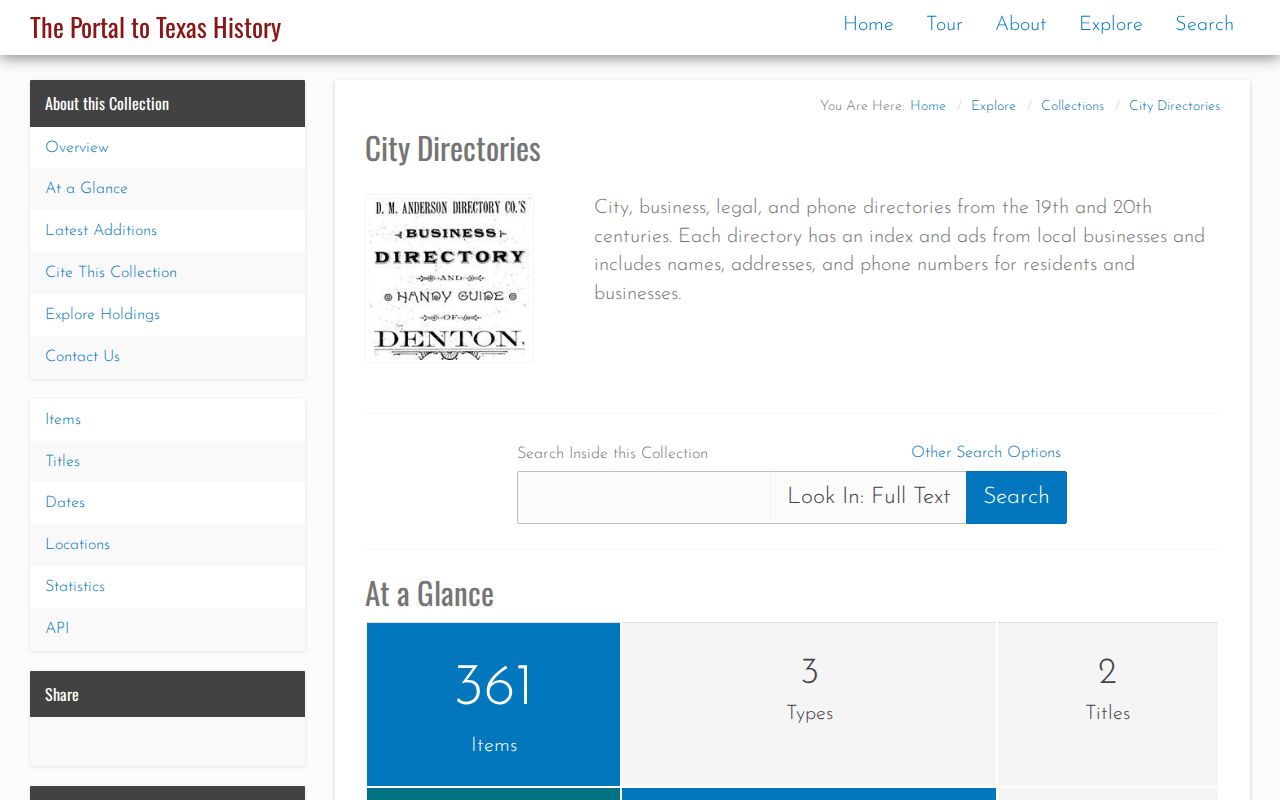
A digitized hit can be useful for a date or spelling, while the local shelf remains the better route for an unscanned year.
Smith County City Directory Access
Tyler Public Library's Local and Family History Room is on the third floor and takes one-hour appointments on Mondays and Wednesdays, with additional time possible through staff. It has two microfilm machines, genealogy computers, a book scanner, and low-cost printing. The room also has newspapers, yearbooks, early maps, cemetery books, Smith County marriage and probate references, and more than 600 rare or out-of-print items. Give staff a name, address, date window, and alternate spelling before the appointment.
The Historical Society archives operate differently. Researchers make an appointment, sign in, use pencils, and do not browse shelves or photograph or scan materials. Staff pull directories, house files, maps, and other files from a detailed topic request. The archive lists ordinary copies at $1 per page and requires email for ordering and payment. Its museum hours are Tuesday through Friday from 10 to 4 and Saturday from noon to 4, while archives are by appointment.
The Historical Society archives page explains the appointment rules and the holdings that complement its printed directories.
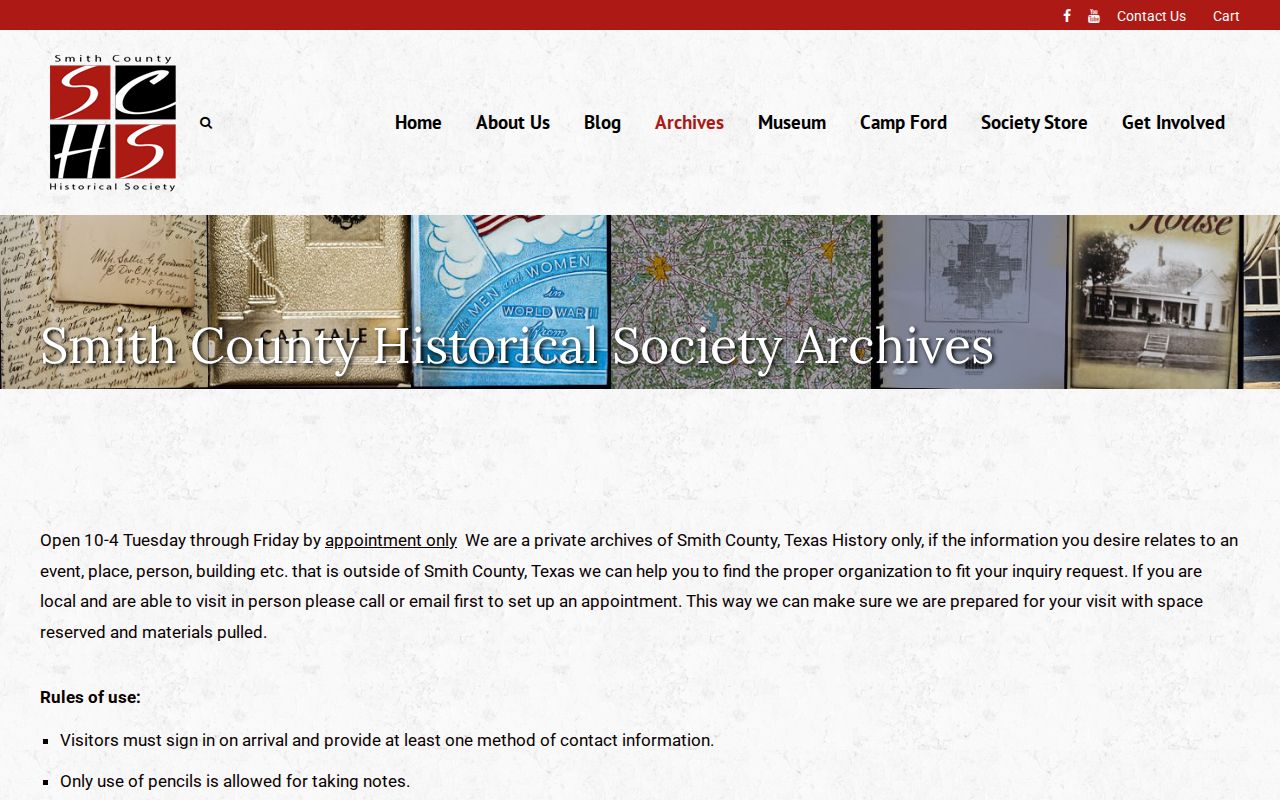
Specific requests help staff locate criss-cross books, maps, newspapers, yearbooks, or a house file without asking them to infer the research target.
Reading Smith County City Directory Entries
The holdings descriptions support a careful inventory, not a fabricated sample. Start with the alphabetical heading, then look for a full name, occupation or pursuit, street address, and any business or employer location shown in that edition. Later Polk volumes can add a telephone reference. The street and householder portion may identify an occupant, office occupant, or business at an address. It does not establish legal ownership or prove a person remained there after the publication date.
| Name heading | The alphabetical entry or business listing used to find a person or concern in that edition. |
|---|---|
| Occupation or pursuit | An occupation or business description when the publisher included one. |
| Street placement | A street, avenue, householder, or office-occupant placement, depending on the volume. |
| Telephone reference | A later numerical or telephone cross-reference where that edition includes it. |
| Classified context | Business classification, city information, institutions, or organizations included by the publisher. |
- Criss-cross directory
- An address-to-occupant or street-order section. It starts with a place and leads back to a listed occupant or telephone reference.
- Householder index
- A section arranged around householders or street locations instead of a simple alphabetical name list.
- Abbreviation key
- A publisher's legend for shortened terms. The local holdings page does not expose a Tyler key, so read the key in the exact volume before expanding an abbreviation.
Smith County City Directory By Address
For an old street question, use the Kriss Kross or Criss Cross material after finding the relevant year. Read the street portion in number order, then return to the alphabetical listing for occupation and any telephone information. This changes the question from where a name appeared to who the compiler listed at an address. It remains an historical directory observation, not a present-day household list.
Address continuity can be weak. Tyler began around the courthouse square and grew through numbered streets, subdivisions, highways, annexed pockets, and rural routes. The research found no authoritative citywide renumbering or renaming year. Compare old street-guide pages, nearby intersections, plats, early maps, and the lot, block, or survey description before connecting an old street label to a current parcel.
Note: A street section can locate a listed occupant for its publication year, but it cannot establish a complete household or a continuous address history.
Smith County City Directories and Census
Follow a household through the actual years on the shelf. A first appearance, an address change, a new occupation, a missing telephone, or a disappearance is a research lead. It is not proof by itself. Federal census schedules are released under a 72-year rule, and their enumeration dates need not match the date a publisher collected directory information. The pair works best when the same name, address, and time window appear across both sources.
- Choose a known name, address, and approximate year, then locate the closest available alphabetical volume.
- Record the printed address, occupation or business context, telephone reference, and the edition date.
- Check the street or householder section for the same address and nearby listed names.
- Repeat with the next available issue, including spelling, initials, married-name, and suffix variants.
- Pair the dated listing with the closest released census schedule, then use deeds, obituaries, probate, or newspapers for a claim that needs confirmation.
A person absent from the next issue may have moved, died, changed name, been omitted, or fallen outside the publisher's coverage. Tyler Library's obituary file and newspaper microfilm, along with Historical Society cemetery and family material, can help test those possibilities. For legal ownership, return to the County Clerk's deed records rather than relying on a directory designation.
Smith County City Directory Gaps
Historical coverage is uneven by year, place, race, and publisher practice. The 1887 description of white inhabitants shows one clear exclusion in the older commercial record. Do not turn an omission into evidence that a person was absent from Smith County. Search related sources with name variants, initials, a married or maiden name, and rural or urban spellings.
The Historical Society's African American Rural Life in Smith County 1870 to 1970 index, African American Life in Tyler index, church and cemetery resources, Cotton Belt News material, and newspapers provide important parallel routes for Black residents and communities. Yearbooks, local organization files, and obituary material can add context, but each has its own scope. Ask archive staff for the community, street, approximate year, and alternate spelling to make the request usable.
Smith County Historical Address Context
Place evidence beside name evidence. The free November 1902 Tyler Sanborn map has 14 sheets that show building footprints, use, streets, hydrants, construction materials, and neighborhood form. It cannot name occupants. Its best use is beside the 1904 directory: the map helps date and situate the building, while the directory gives a contemporaneous name, occupation, or address listing.
For broader context, the county's 2025 Historical Atlas project describes landmarks, historic routes, more than 200 cemeteries, and popup cards with documents and photographs. Those materials can explain an old community or road name. They should not be used as a current resident source. The result is a more defensible family or house history because each source keeps its own job.