
Smith County Resident Lookup Records
The search should ask a narrow question first. An appraisal card can connect a named owner to a parcel and a mailing destination. A voter record can confirm registration status under the Texas rules. Court, deed, vital-index, license, and historical sources each establish a different kind of connection. None is a complete household list, and the source that contains a name may not establish that the person lives at a particular address today.
| Record | What It Confirms | Where to Search | Access |
|---|---|---|---|
| Appraisal or tax account | Owner, parcel, situs, mailing address, and account indicators | Smith County Appraisal District or Tax Assessor-Collector search | Public search; a mailing address is not occupancy proof. |
| Recorded land index | Grantor or grantee role, instrument, date, and legal description | Smith County Clerk Official Public Records Search | Index/OCR search; copies and images may require purchase or office access. |
| Voter registration | Registration status and public voter fields | Texas My Voter Portal | Public fields are limited by Texas election law. |
| County and district cases | Party role, court, filing, events, and disposition where public | Smith County Public Search Site | Online dates and images vary; clerks supply the fallback. |
| Vital indexes | Historical event leads and marriage or divorce verification leads | Texas DSHS indexes | Indexes are not certificates and protected copies have eligibility rules. |
Use the record closest to the fact being tested. Begin with an owner search for a known parcel, the voter portal for registration status, or a dated court or deed record for a public filing role. Then add one independent anchor before calling two similar names the same person.
Smith County Voter Lookup Details
Texas My Voter Portal accepts a VUID, a Texas driver-license number when it was supplied at registration, or a first and last name. The state workflow also uses county, date of birth, and ZIP when displaying voter information. For a Smith County search, compare the returned county and status before treating a common name as a match. “Suspense” means the registrar has reason to question the residential address, such as returned mail. It does not mean the voter has lost active voting status.
The public side is limited. Texas Election Code sections 13.004 and 18.005 protect Social Security numbers, driver-license and DPS ID numbers, telephone numbers, protected addresses, and ballot choices. Name, date of birth, VUID, and elections participated in may be public under the statutory scheme. The portal is an individual registration lookup, not a map of nearby people or a roster of every Smith County household.
Note: Smith County Elections Administration can route registration questions when the online result is unclear, but staff should not be asked to disclose a protected address.
The official My Voter Portal search screen uses those lookup paths. Use a result as one identity anchor and keep protected fields out of any notes or sharing.
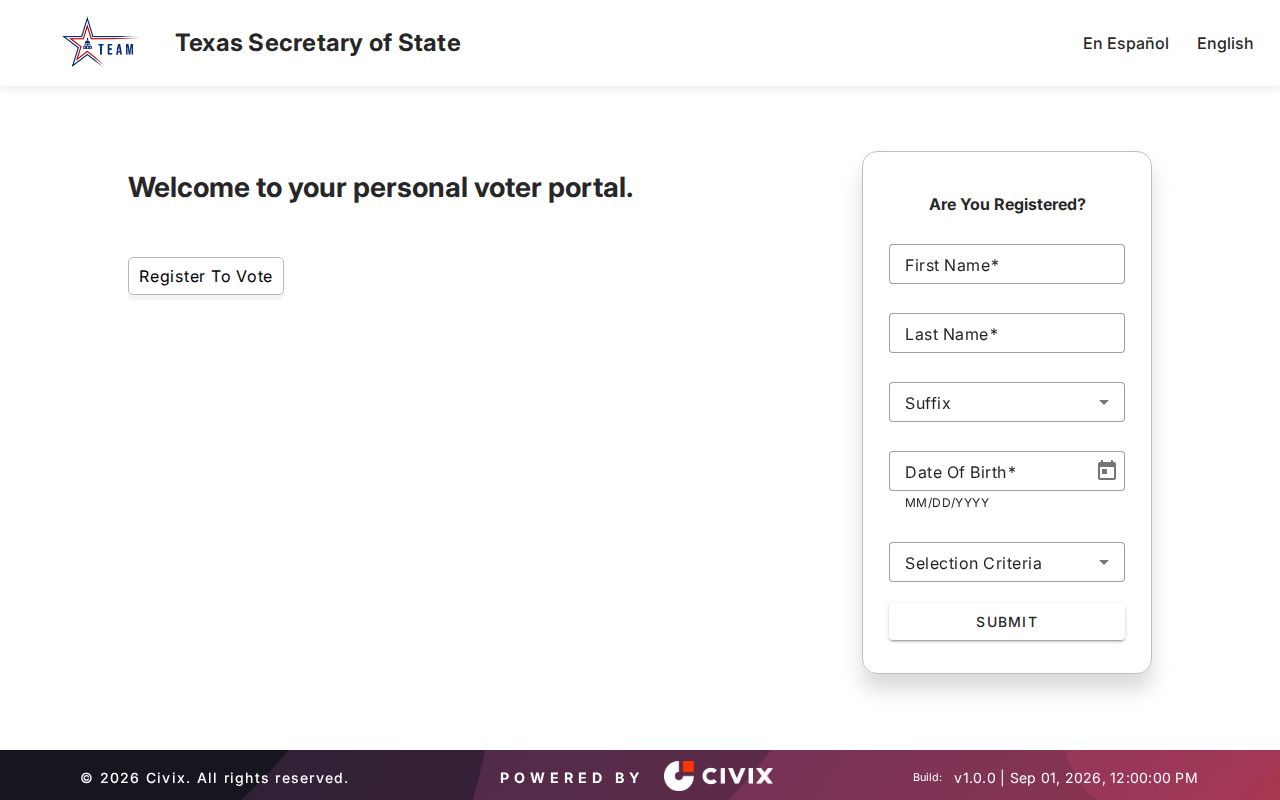
The portal helps confirm a registration workflow; it does not turn a voter entry into proof of present household occupancy.
Smith County Court Name Matches
The Smith County Public Search Site routes county and district judicial material, while Records Services reports online coverage for civil cases from 1997, criminal cases from 1995, and probate cases from 1992. The District Clerk notes felony and divorce records online, and County Clerk misdemeanor staff can search Class A and B records back to 1976. Because the live gateway is JavaScript-driven, its exact field labels were not confirmed in the research. Search a full legal name and variants, then narrow with a case number, court, date range, or party role when those controls are available.
A result is a case reference, not a conclusion about a person. A public docket may show a case number, style or party names, filing date, assigned court, category, event dates, attorney or bondsman fields where exposed, disposition, and document links when allowed. Compare the filing court and case number against another record. Probate indexes are online, but probate images are available through the County Clerk office rather than as a promise of online access.
| Result field | How it helps identify the correct person |
|---|---|
| Case number | A stable reference for requesting the correct file or copy. |
| Party role and case type | Separates people who share a name and clarifies the narrow record connection. |
| Filing date and court | Tests whether the record fits the known time and county. |
| Disposition or judgment | Must be read in context; a filing alone is not a final result. |
| Document-access indicator | Shows whether a permitted image is available or a clerk request is needed. |
Smith County Same-Name Checks
Smith County surname searches need room for initials, married or maiden names, suffixes, hyphenated forms, and ordinary spelling differences. The reliable result is a two-anchor match. Pair a name with a parcel or legal description, a VUID or date-of-birth range, a spouse or public business role, or a court number and filing court. A name match by itself is weak, especially when the record comes from a statewide or historical index.
For an ownership lead, the Tax Assessor-Collector search distinguishes the actual property location from the owner mailing address. Its help directs address searchers to use the street number and name without the street type or direction. Compare the situs, account, legal description, and exemption indicator rather than converting a mailing address into a current-residence claim. The same discipline applies to a license or business filing: it can establish a public affiliation, not a personal residential location.
Verify a Smith County Resident
To look up a resident carefully, build a short chain of dated records. Start with the strongest name version and the location or time period already known. Smith County’s property, court, and clerk systems give different kinds of anchors. Texas vital records and licensing sources can add a limited corroborating detail, but they should not be used to press a custodian for protected information.
- Search the name and its variants in the voter portal, then compare the county, ZIP, and status where public.
- Check SCAD and the tax search for an owner name, parcel, property location, mailing address, and exemption indicators. A common-name match alone does not settle identity.
- Search the County Clerk and District Clerk routes for dated public filings. Record the case number, party role, court, and filing date.
- Use a public vital index or public professional record only to corroborate the time, name form, or affiliation. Request a certified copy only from its proper custodian and only when eligible.
- Docket
- A court’s running list of filings, events, and orders in a case. It is not the same as a final judgment.
- Index and image
- An index points to a record and its identifiers. An image is the document view, which may be restricted, watermarked, or available for a copy charge.
- Certified copy
- A copy issued and authenticated by the office that holds the original record. A search result or verification letter is not automatically a certified copy.
Smith County Vital Index Paths
Vital records have a local boundary split. The Smith County Clerk is local registrar for birth and death events outside Tyler city limits and issues copies of Smith County marriage licenses. Tyler’s health department handles the city-classified birth and death records for events inside Tyler. The Texas Department of State Health Services handles statewide certificates and verification products. A marriage verification is not the certified license, and a divorce verification is not the certified decree.
Texas Government Code section 552.115 opens birth records on the 75th anniversary and death records on the 25th anniversary, with a separate rule for an unidentified decedent. DSHS marriage indexes begin in 1966 and divorce indexes in 1968. They can supply names, dates, and county leads but are not comprehensive legal documents. When an event falls before those index years, ask the Smith County Clerk or District Clerk for the correct local record route.
The Texas online vital-record ordering service handles eligible orders and verifications, while the local custodian remains the source for a Smith County license or decree.
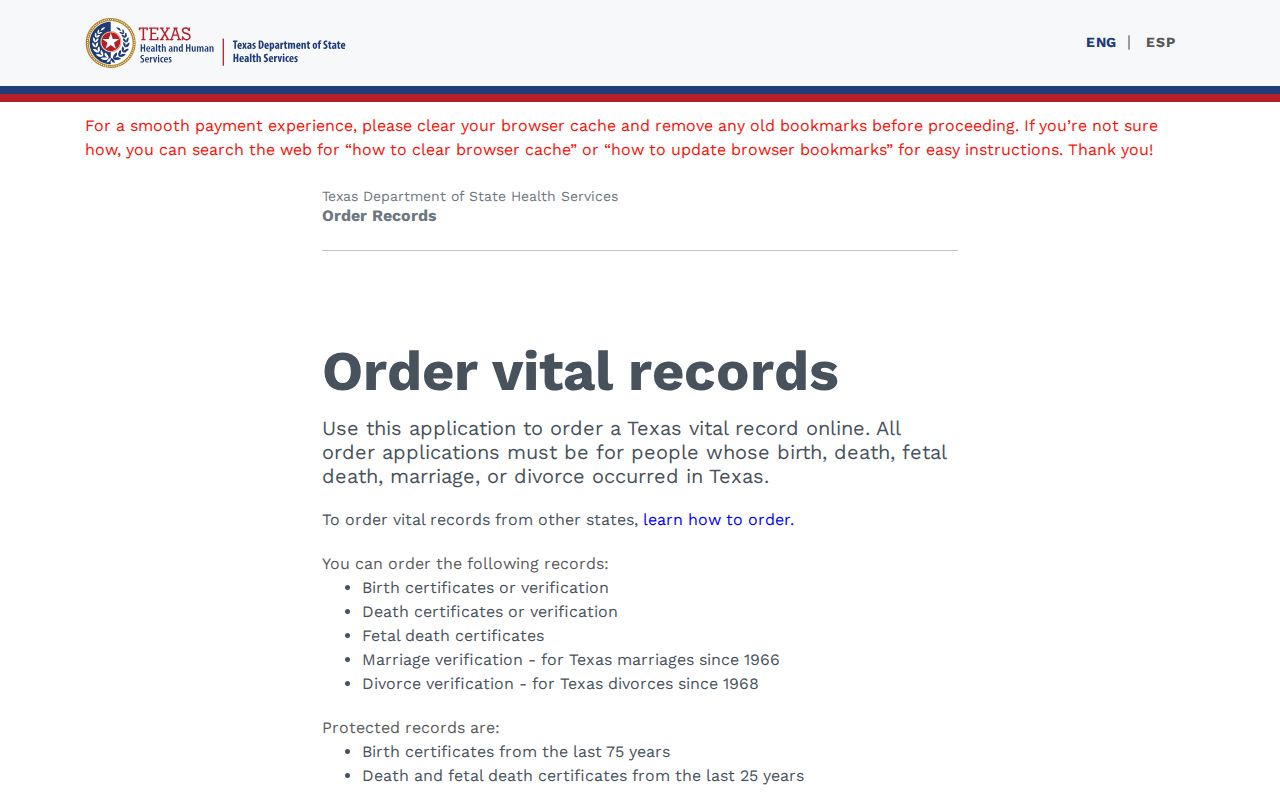
Recent certificates remain protected, so an index hit should lead to the proper eligibility and copy process, not to an assumption of access.
Smith County Family Reconnection Records
Some Smith County searches are historical and personal rather than current. A probate case may connect a decedent to heirs, property, and addresses through public applications, inventories, orders, and later deeds. Search the probate index by the decedent’s name, then use the County Clerk’s copy path for material that is public. Sealed or confidential matter remains unavailable. An obituary or a cemetery reference can provide a family lead, but it needs confirmation from the record custodian when an official fact matters.
For a former classmate, Tyler Public Library holds yearbooks for Tyler High, John Tyler, Robert E. Lee, and Tyler Junior College. The Smith County Historical Society holds yearbooks from 1909 through 2005, alongside newspapers and local files. Those sources establish a dated school or community connection, not a current address. Adoption records follow Texas DSHS registry and confidential-intermediary procedures, not a public-record shortcut.
Smith County Records Request Fallback
When a search returns no row, ask whether the record is held by the County Clerk, District Clerk, Records Services, a Tyler office, or a state custodian. Smith County Records Services handles inactive material, and the County Clerk’s historical microfilm path reaches older deed and court material. The official online deed portal does not state its start year, while the Texas State Library guide documents Smith County deed records from 1846. A blank modern index therefore does not establish that no historical record exists.
Under the Texas Public Information Act process, request an existing identifiable record with a date, address, case number, parcel, or document number. Government bodies generally release public information promptly or provide written notice within ten business days if more time is needed. Judicial records and protected vital material follow their own access rules, so the clerk or custodian is the right channel for those items.
Note: Preserve the exact spelling, date range, portal scope, and record identifier used in a failed search before asking a custodian for help.
Smith County Resident Lookup Limits
Texas law opens selected public fields but protects confidential addresses, recent vital certificates, sealed and juvenile court material, adoption files, and personal DMV information. SCAD’s Internet Opt Out can suppress name and account information on district websites, though it does not erase property-tax information from public access under the Texas Public Information Act. For a wrong instrument, license, or record, keep the document, account, case, or file number and ask the specific custodian for its correction or redaction procedure.
Lawful use. Use a Smith County resident lookup for personal, lawful research, family history, public-record verification, or reconnecting through an appropriate channel. Never use a record to stalk, harass, intimidate, or harm anyone.